
What "strategy" actually means in Crazy Time

The wheel result is RNG-driven, certified independent spin to spin. No crazy time betting strategy and no bet pattern reduces the long-run house edge. Evolution Gaming (NASDAQ: EVO) is a publicly listed company; its RTP figures are independently certified by eCOGRA and sourced from the published paytable. RTP ranges from 94.41% on Pachinko and the Crazy Time bonus round to 96.08% on Coin Flip. Those values are fixed properties of the bet types, not levers any stake pattern or session timing can shift.
The best crazy time strategy works within the four variables actually in a player's control: how much enters the session (bankroll), how much per spin (stake size), how the stake is distributed across the seven betting options (bet spread), and when the session stops (session length, stop-loss, stop-win). Each variable shifts the variance profile of a session. None shifts the long-run expected return. The rest of this page treats those four axes as the actual strategy surface.
House edge per bet type at a glance
The table below shows the long-run house edge for every bet type on Crazy Time. House edge is what the casino keeps over the long run on every INR wagered: 3.92% on Coin Flip means INR 3.92 of every INR 100 over thousands of spins; on the Crazy Time round the same INR 100 loses INR 5.59 long-run. Hit frequency is how often the segment lands per spin, sourced from Evolution's published paytable. Both columns are fixed properties of the bet, not session-level levers.
| Bet type | RTP | House edge | Hit frequency |
|---|---|---|---|
| Number 1 | 95.39% | 4.61% | 38.9% (21 of 54) |
| Number 2 | 95.39% | 4.61% | 24.1% (13 of 54) |
| Number 5 | 95.39% | 4.61% | 13.0% (7 of 54) |
| Number 10 | 95.39% | 4.61% | 7.4% (4 of 54) |
| Coin Flip | 96.08% | 3.92% | 7.4% (4 of 54) |
| Cash Hunt | 95.27% | 4.73% | 3.7% (2 of 54) |
| Pachinko | 95.02% | 4.98% | 3.7% (2 of 54) |
| Crazy Time round | 94.41% | 5.59% | 1.85% (1 of 54) |
The lowest house edge sits on Coin Flip at 3.92%, the highest on the Crazy Time round at 5.59%. Number bets share 4.61% across all four (the RTP is identical at 95.39% per the paytable; the hit rate differs but the long-run return per INR wagered does not). On a INR 1,000 session at 100 spins of INR 10 stake, the expected long-run loss reads INR 39 on Coin Flip, INR 46 on number bets, and INR 56 on the Crazy Time round; variance during a single session swings the actual result far above and below those figures.
Bankroll session models for INR play
Crazy time bankroll management starts with matching the stake size to the wallet before the session begins. The late-evening 9 pm to 1 am IST window is the typical Indian working-night session; the Micro INR 500 model is the practical starting point for crazy time strategy for small bankroll play, where the goal is session length rather than chasing a single large payout. Three models cover the range: Micro INR 500, Standard INR 2,000, and Extended INR 5,000. Each row in the table below pairs a starting stake with a per-spin bet, a target spin count, an approximate variance range, and a stop-loss line.
| Session type | Starting stake (INR) | Bet per spin (INR) | Target spins | Approximate variance range (INR) | Stop-loss (INR) |
|---|---|---|---|---|---|
| Micro | 500 | 10 | 50 | +/-200 | 250 |
| Standard | 2,000 | 50 | 40 | +/-800 | 1,000 |
| Extended | 5,000 | 100 | 50 | +/-2,000 | 2,500 |
Micro session (INR 500 starting stake)
The Micro model puts INR 10 per spin across roughly 50 spins, with an approximate variance band of +/-INR 200 and a stop-loss at INR 250 (a 50% drawdown line). At 95.39% RTP, the long-run expected loss across those 50 spins is approximately INR 23. Actual single-session outcomes can swing roughly +/-INR 200 either side of that expected value. The Micro session suits a one-evening trial after a first deposit, where the goal is to learn the wheel rhythm without putting the rupee bankroll at meaningful risk.
Standard session (INR 2,000 starting stake)
The Standard model places INR 50 per spin across 40 spins, with an approximate variance band of +/-INR 800 and a stop-loss at INR 1,000. At 95.39% RTP, the expected loss across those 40 spins is approximately INR 92, calculated round-by-round. The actual session result will land somewhere inside the approximate variance window most of the time, with bonus-round triggers responsible for the wider swings. For the full bet-type breakdown that informs spread choice within this model, see the RTP per bet type page.
Extended session (INR 5,000 starting stake)
The Extended model uses INR 100 per spin across 50 spins, with an approximate variance band of +/-INR 2,000 and a stop-loss at INR 2,500. At 95.39% RTP, the long-run expected loss across those 50 spins is approximately INR 230. The Extended bankroll fits the Tier-2 city wallet that holds back a weekend or post-IPL-match window for live play, where a single longer session replaces several Micro trials. The wider variance band reflects more spins exposed to the bonus rounds, not a higher house edge.
Pick the row that matches the wallet, then keep the bet per spin under 5% of the starting stake regardless of which spread comes next.
Bet-spread examples across segments
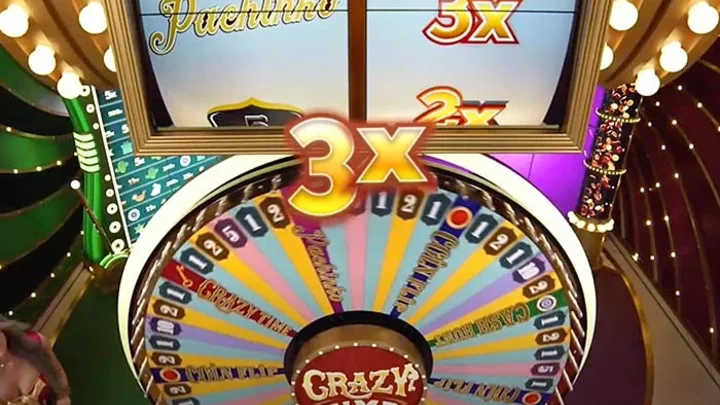
Three spread templates cover the range from low-variance to high-variance play across the seven betting options. These spread patterns describe different variance profiles, not winning setups. The best segment to bet on in Crazy Time depends on the variance a player can absorb, not on which segment last hit. For the full payout mechanics and the 5-second betting window, see Crazy Time rules. The numbers below are segment hit rates and payouts from the 54-segment wheel: segment 1 at 38.9% (21/54) paying 1:1, segment 2 at 24.1% (13/54) paying 2:1, segment 5 at 13.0% (7/54) paying 5:1, segment 10 at 7.4% (4/54) paying 10:1, Coin Flip at 7.4% (4/54), Cash Hunt at 3.7% (2/54), Pachinko at 3.7% (2/54), and the Crazy Time round at 1.9% (1/54).
Conservative spread
Allocation: 1: 80% | 2: 20%. Segment 1 lands 38.9% of the time and segment 2 lands 24.1%, so the combined hit rate sits above 60% on most spins. Payouts per hit stay small because both bets pay 1:1 and 2:1. The session swing stays narrow because dry stretches are short. The Conservative spread suits the Micro and Standard models, where the wallet cannot absorb a long bonus drought and the goal is extending session length over chasing a bonus-round multiplier.
Balanced spread
Allocation: 1: 50% | 2: 30% | Coin Flip: 20%. The two number bets keep the hit frequency high; the Coin Flip allocation adds upside through a bonus round that triggers on 7.4% of spins and yields an average 11.71x multiplier when it lands. The variance band widens because Coin Flip drought stretches occur, then resolve in a single round that pays back several spins. The Balanced spread suits the Standard and Extended models, where the bankroll can carry a 15-spin Coin Flip dry stretch without breaching the stop-loss.
Aggressive spread
Allocation: 1: 40% | Coin Flip: 15% | Cash Hunt: 15% | Pachinko: 15% | Crazy Time round: 15%. This spread carries the highest variance on the page. Cash Hunt and Pachinko each trigger on 3.7% of spins; the Crazy Time round triggers on 1.9%. Most of the rupee allocation is waiting for events that hit infrequently. The Aggressive spread offers the largest exposure to the 25,000x payout ceiling, and also the longest unprofitable stretches. It suits the Extended model only, where the INR 5,000 bankroll can absorb 30 to 40 dry spins before a bonus round resets the session.
For the bet-type RTP figures behind each spread, see the full RTP table; for current segment counts and recent bonus-round frequency, see the live stats scoreboard page.
Cash Hunt and the picking question

The crazy time cash hunt strategy question reduces to a single mechanic: Cash Hunt presents a 108-symbol grid once the round triggers, and the RNG assigns multiplier values to the symbols before the picking phase begins. The shuffle animation that flips the grid is visual presentation; the underlying value-to-symbol map is locked in at the moment the bonus round opens.
Every symbol is equally likely to conceal any multiplier value at the moment the player picks. The host has no influence over which symbol holds which multiplier. The shuffle does not redistribute values during the pick window: it shows the grid mixing, while the value map sits already fixed underneath.
Expected value carries identical figures across every picking path. Switching, sticking, picking the corner, picking the centre: each path returns the same expected value at the published 95.27% Cash Hunt RTP. A player who picks the first symbol the moment the grid stops moves the expected return by zero. A player who waits the full 9 seconds before locking a pick carries the same expected return. For the round-level breakdown of the picking phase, see the Cash Hunt picking mechanic page.
Tips and tricks: what the variance data shows

Four crazy time betting tips india players repeat most often, and the variance data answers each. Crazy time tactics built around "segment 1-only betting" start with a correct observation: segment 1 lands 38.9% of the time and pays 1:1, with a long-run RTP of 95.39%. Across 1,000 consecutive spins the expected hit count is 389, but actual results can land 100 to 150 spins above or below that expected value; the crazy time spin history archive on this site logs actual hit counts over a rolling 200-spin window. The bet keeps variance low; it does not lift expected return above the published RTP for any single session.
Tip two says skip a few rounds after a big win. Each spin is independent of the previous one. The wheel has no memory: the sequence of prior results carries no information about the distribution of the next spin. Skipping ten spins after a Pachinko hit changes the player's spin count, not the probability that the eleventh spin lands on any segment.
Tip three says watch the host's wrist before the spin. Flapper momentum is mechanical; live-camera observation does not change the probability distribution of the segment the flapper stops on. The studio uses a calibrated wheel and an independent flapper release; nothing visible to the live-stream viewer alters the segment probabilities for the next spin.
Tip four says increase bet size after losses, the Martingale pattern. Two real-world constraints break the chain: table-limit caps and bankroll exhaustion. The published max bet at most India-facing casinos sits at INR 2,50,000 or higher, which sounds far away until the doubling sequence runs. Starting at INR 50 and doubling on each loss, the 11th consecutive loss puts the next stake at INR 50 x 2^10 = INR 51,200, with cumulative stake across the chain reaching INR 1,02,400 on that 11th bet. The Standard INR 2,000 bankroll runs out before the 7th doubled stake: INR 50 then 100 then 200 then 400 then 800 then 1,600, summing to INR 3,150 cumulative, well past the bankroll line.
Telegram signal bots and predictor apps in India

The wheel result is RNG-anchored at the studio, with each spin drawn from a process independent of the previous outcome. Past results contain zero information about the next result. Pattern-based signal bots that read recent spin history and forecast the next segment claim to extract data from a sequence that does not contain it. The mechanism that would let a signal work is absent at the source.
Crazy time predictor app products and crazy time signal bot telegram channels share the same mechanism failure. A predictor that tells the player segment 5 will hit on the next spin carries the same accuracy as the base segment probability: 13.0% for segment 5, 7.4% for Coin Flip, 3.7% for Pachinko, 1.9% for the Crazy Time round. The full mechanism breakdown, including how predictor apps source their displayed accuracy figures, sits on the crazy time predictor breakdown, which also covers signal Telegram channels and hack APK claims.
Crazy Time predictor explainedVariance: what one INR 2,000 session can actually do

Crazy time variance explained in practical INR terms: one Standard INR 2,000 session can end at INR 0 or at INR 4,500 or higher depending on bonus-round triggers and Top Slot stacks. The long-run expected loss of approximately INR 92 is the average across many sessions, not the typical single-session outcome. Net winnings are subject to 30% TDS, withheld by licensed operators before the INR balance is credited, so the real-money session result always factors that deduction; the UPI-friendly casino shortlist highlights operators that handle INR sessions and withdrawal checks.
The variance band shows why a single session result cannot be read as a verdict on the bankroll model. For the stop-loss, session-limit, and deposit-limit settings that keep variance from breaching the planned bankroll, see the responsible play tools overview.
Strategy FAQ

Is there a Crazy Time strategy that works?
No bet pattern reduces the long-run house edge. What players control is bankroll, stake size, bet spread, and session length. RTP ranges 94.41% to 96.08% across bet types. Strategy here means stake discipline.
What is the best Crazy Time bet for small bankrolls?
The number bet 1 carries 95.39% RTP and lands 38.9% of the time, the highest hit frequency on the wheel. Small bankrolls (INR 500 to 2,000) keep variance manageable when concentrated on 1 and 2.
What does bankroll management mean in Crazy Time?
Bankroll management means a fixed deposit, a per-spin stake under 5% of that deposit, a stop-loss at roughly 50% of bankroll, and a session length matched to spin count. See the BankrollTable above.
Does picking strategy work in Cash Hunt?
No picking approach affects the expected return. Multiplier values are locked to the 108 symbols before the player picks. Every symbol is equally likely to reveal any multiplier value at the moment of pick.
What is the best segment to bet on in Crazy Time?
Segment 1 has the highest hit rate (38.9%) and the lowest variance. Coin Flip carries the highest RTP (96.08%) but triggers only 7.4% of spins. The best segment depends on the variance the player can absorb.
Do Crazy Time Telegram signal channels work?
No. Each spin is RNG-independent of the previous one, so historical results contain no information about the next outcome. Many India-facing signal channels also collect a non-recoverable UPI fee for access.
What is variance in Crazy Time?
Variance is the gap between long-run expected return and a single session's actual outcome. A 40-spin INR 2,000 session can close anywhere from INR 0 to INR 5,000+ depending on bonus-round triggers.
How long should a Crazy Time session last?
Match session length to the BankrollTable above: 50 spins for Micro and Extended, 40 for Standard. Stop at the stop-loss line or after the planned spin count, whichever comes first.
Are there Crazy Time tricks or tips that improve odds?
No. Each spin is RNG-independent. segment 1-only betting, skip after a big win, increase bets after losses: none of these change the probability distribution. They only change the variance the player carries.
What is a Crazy Time predictor and does it work?
A Crazy Time predictor claims to forecast the next segment from past spins. It cannot: each spin is independent. For the full mechanism breakdown, see the Crazy Time predictor explained page.
Are there Crazy Time cheats or hacks that work?
No. Every spin is RNG-independent and certified by eCOGRA. No app, signal channel, or 'crazy time hack' affects the wheel result. Apps marketing themselves as crazy time hack apk or crazy time cheat tool are scams; some additionally collect a non-recoverable UPI access fee or harvest banking OTPs. The only levers a player controls are bankroll, stake size, bet spread, and session length.
How to beat Crazy Time over a session?
Statistically, players cannot beat Crazy Time over the long run because the house edge is built into the paytable: 3.92% on Coin Flip up to 5.59% on the Crazy Time bonus round. Variance lets a single session close above expected return; that is variance, not 'beating' the game. Bankroll discipline matters more than bet pattern. Crazy time tricks and tips that promise an edge are misframed; the only honest tricks are stake limits, stop-loss lines, and a fixed session length.